
Last week the government released a research report on the wellbeing of children and young people over the academic year 2021 to 2022. The report included research into bullying and online bullying. The government also released guidance for schools relating to children missing school due to mental health issues.
The research report looked at available research relating to children's wellbeing and safety at school. The below focuses on the bullying elements within the research report, but you can read more about wider experiences in the report.
In school bullying experiences
The research report showed that 23% of parents of children and young people (CYP) at primary school report being bullied in the last 12 months and 22% of CYP at secondary school report being bullied in the last 12 months.
It showed that CYP with special educational needs (SEN) and those in receipt of Free School Meals are significantly more likely to report being bullied. This chimes with our own research of over 25k participants: https://bit.ly/3YQ75Fn
It also shows:
- Primary age: Parents of white CYP are a bit more likely to report their child has been bullied in the last 12 months than parents of CYP from ethnic minorities.
- Secondary age: White CYP are a lot more likely to report being bullied in the last 12 months than CYP from ethnic minorities.
NB: The research uses Government terminology and its guidance states: "We use ‘ethnic minorities’ to refer to all ethnic groups except the white British group"
You can read our own literature review on racist and faith-targeted bullying.
Image

Online bullying experiences
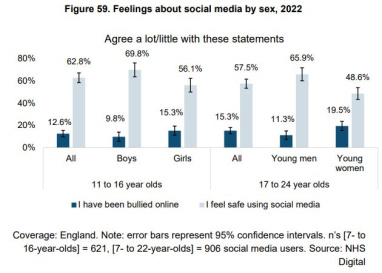
The research report also found evidence that a sizeable minority of CYP have negative experiences with social media, with around 1 in eight 11-16 year olds and 1 in seven 17-24 year olds reporting they have been bullied online. Girls were reporting being more at risk.
Image
About the research outlined:
The research from the report relating to in school bullying comes from the first collection of the National Behaviour Survey. The data has yet to be published but is expected in June 2023.
The research relating to experiences online comes from an NHS survey looking at the Mental Health of CYP People
New guidance "Summary of responsibilities where a mental health issue is affecting attendance"
Read the new non-statutory guidance
The keys points from the guidance which could be pertinent to bullying:
- Schools play and important role in teaching children about relationships including through the Relationships and Sex Education curriculum
- Schools should have a whole-school approach to pupil mental health and can access senior mental health lead training
- It is not the role of a school to diagnose pupils
- Schools should work togehter with parents at an early stage to try to mitigate the issues relating to child missing school including helping pupils to navigate difficult emotions (which could include friendships)
- Schools must be mindful of their duties under Keeping Children Safe In Education
Schools should also follow the wider guidance for schools about improving attendance. This guidance mentions the importance of addressing the interplay with other issues that can relate to poor attendance in school and specifically mentions bullying: Working together to improve school attendance Guidance for maintained schools, academies, independent schools, and local authorities