
Rating description:
- Fully met: We collect data about whether this group is more at-risk of being bullied / bullying others (or if this type of bullying is an issue in school), and this data shows us they are not more at-risk than their peers (or the type of bullying isn’t a concern within school). We also actively work to prevent and respond to any bullying targeted at these pupils.
- Partially met: We collect data about whether this group is more at-risk of being bullied / bullying others (or if this type of bullying is an issue in school), and this data highlights that this group is more at-risk (or this type of bullying is an issue in school), therefore we are actively working to prevent and respond to this type of bullying.
- Not yet met: We do not collect data about whether this group is more at-risk of being bullied / bullying others (or if this type of bullying is an issue in school).
Why is this important?
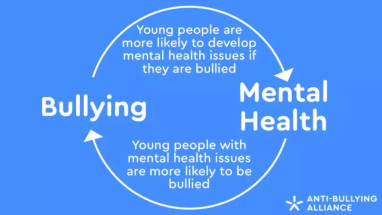
Research shows that there is a strong link between mental health and bullying - children and young people who have experienced bullying are more likely to experience mental health issues, and those who have mental health issues are more at-risk of experiencing bullying, as the diagram below demonstrates. In fact, being a victim of bullying can increase the risk of being depressed in later life by more than half. But by systematically recording and addressing these incidents, as well as raising awareness and celebrating difference across the wider school community, schools can help tackle these issues, identify patterns, implement targeted interventions, and provide tailored support to vulnerable groups. This proactive approach not only helps prevent further harm but also fosters a school culture where diversity is celebrated, and all pupils feel valued and safe.
Top Tips:
- While we know that children who have mental health issues may be more at risk of bullying than their peers, it is important to acknowledge that this is because of external factors, attitudes of others, group dynamics, perceived differences, and systems in which children and young people live and learn; we should never imply to children that they are bullied because of who they are.
- Pupil voice is key to stopping bullying and improving wellbeing of young people and can help to ensure that children are able to talk when they are worried about something. This infographic which was developed with Tootoot for Pupil Voice Week provides top tips on how to encourage pupil voice.
- We have a free short online training module on mental health and bullying.
Resources & Examples:
Resources:
- See ABA's mental health and bullying website page for information and resources
- Complete our Mental Health and Bullying online CPD course
- The Department for Education published Mental Health and Wellbeing Resources for Teachers and Teaching Staff in April 2024. They also have information and guidance about the education staff wellbeing charter and how to use it.
- NHS Every Mind Matters are resources about looking after your mental health, which could be useful to share with pupils, staff and parents/carers.
- Anna Freud have lots of resources around mental health in schools, including:
- A classroom wellbeing toolkit for secondary school staff, sharing practical steps to promote and support mental health through everyday interactions with students.
- The Let’s talk about anxiety animation and resource toolkit helps students aged 11 to 13 to normalise, understand and manage anxious feelings.
- Mental health lead resource hub for a whole-school approach to mental health.
- Talking racism and mental health in schools: a series of five podcast episodes featuring mental health, anti-racism and education experts.
- Place2Be co-ordinate Children's Mental Health Week every February, and have resources and information that might be useful all year round.
- Ditch the Label have a module aimed at promoting positive mental health outcomes, by empowering students with the tools to take control of their own mental health journey and open up a conversation with someone who may be struggling with their mental health.
- The UK Trauma Council have developed resources based on a set of 5 principles to support the educational communities in providing a comprehensive and compassionate response to traumatic events that affect children and young people in their care.
Examples:
Please note that examples from primary and other school settings may still include some useful hints and tips you can adapt and apply for a secondary setting.
- The Children and Young People’s Mental Health Coalition have published a collection of Case Studies of Best Practice for Behaviour and Mental Health in Schools
- ABA have collated various initiatives used by schools to support pupils' mental health that then have an impact on dealing with bullying
- Primary School Case Study - on understanding the link between bullying and mental health
- Primary School Case Study - on training older pupils to support others
- Secondary School Case Study - on reviewing the whole-school approach to supporting pupils' mental health
See below for quotes and pieces of advice from other schools:
- "It has been particularly useful to have a Senior Mental Health Lead who has been able to access training by the Anna Freud Centre. This has provided our school with an excellent range of resources to support both staff, pupils and parents"
- "The mental health of a child can be severely damaged by the experience of being bullied and it is necessary that this is taken into account when dealing with an incident. Putting in place pastoral care, both adult and peer, and working with the parents, helps the children to feel supported and listened to."
Back to 7. At risk groups page
Note: the resources listed at the bottom of this page (below) have all been referenced in the text above.